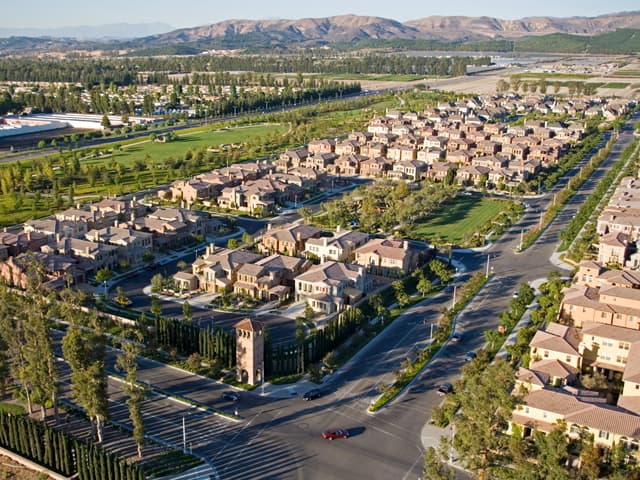
Woodbury community in Irvine CA
$1.1M – $3.5MBuilt 2004 – 2012

Woodbury

Family-first community with resort amenities

Woodbury is one of Irvine's largest and most complete planned villages, with homes priced from $1.1M to $3.5M built between 2004 and 2012 across several thousand units ranging from attached condominiums to detached single-family homes. The community infrastructure is exceptional: six pools, a walkable Pavilions-anchored town center, Jeffrey Trail Middle School embedded within the village, and the Jeffrey Open Space Trail running through the community. It feeds to Northwood High School — consistently ranked among the top public high schools in Orange County — and is cited by longtime residents as one of the best family communities in Southern California. Woodbury's Mello-Roos assessments fund the community infrastructure that makes it distinctive; buyers who factor these into total carrying cost find the value calculation still favors Woodbury over comparable Irvine addresses. The combination of community depth, school quality, walkable retail, and accessible price range makes Woodbury one of Irvine's most consistently in-demand neighborhoods.

$1.1M – $3.5M
Price Range
1,200 – 4,500 sq ft
Home Sizes
~$175–$375/month (master + sub-HOA)
HOA
2004 – 2012
Year Built
Highlights
  • Six community pools — each with a distinct character and purpose
  • Woodbury Town Center: Pavilions, dining, Starbucks, and daily services
  • Jeffrey Trail Middle School campus embedded within the village
  • Jeffrey Open Space Trail running through the community
  • Northwood High School — top 3 in IUSD for AP enrollment and UC admissions
IUSD Schools
  • ElementaryWoodbury Elementary
  • MiddleJeffrey Trail Middle School
  • High SchoolNorthwood High School
Builders
William Lyon HomesShea HomesStandard PacificKB Home
Overview

Woodbury is the Irvine village that most families describe as getting Irvine right. It's large enough to have real infrastructure — a walkable town center anchored by Pavilions, six community pools, sports parks, and schools embedded within the neighborhood — without losing the community cohesion that smaller developments sometimes achieve more easily. Residents tend to stay. The community has a social fabric that takes years to build: neighbors who know each other's children, a PTA that actually functions, a farmers market that draws from across Irvine. That's what low turnover looks like from the inside.

The Scale of Woodbury — and Why It Works

Woodbury is one of Irvine's largest planned communities, encompassing approximately 4,000 homes across multiple sub-neighborhoods built between 2004 and 2012. The scale creates genuine diversity — product types range from attached condominiums and townhomes starting around $1.1M to larger single-family detached homes on premium lots approaching $3.5M. This range means Woodbury serves first-time Irvine buyers, growing families, and established professionals all within the same community boundary.

The sub-neighborhoods within Woodbury each have their own HOA, architectural character, and street identity. Ashbury, Bridgepark, Claircrest, Eastbourne, Fieldstone, and the other named villages within the broader Woodbury master plan create a layered community — residents identify with both their immediate sub-neighborhood and the larger village. The master HOA governs the town center, major parks, and community-wide amenities; sub-HOAs manage landscaping, private parks, and product-specific maintenance.

Streets in Woodbury are well-landscaped and maintained to a standard that reflects consistent HOA investment over the community's twenty-year life. Walking through Woodbury on a weekday morning, you encounter parents with strollers, high school runners logging miles, and retirees exercising dogs — a social texture that indicates a neighborhood that functions rather than a collection of houses that happen to share a zip code.

Woodbury Town Center: What's Actually There

Woodbury's walkable town center is one of the features that most consistently surprises buyers who haven't visited the community before. The center is anchored by a full-service Pavilions grocery store — not a convenience market, but a complete grocery with a deli, wine section, floral, and pharmacy. Around the Pavilions anchor: a Starbucks, multiple sit-down and fast-casual restaurants spanning Chinese, Japanese, Mediterranean, and American cuisine, a fitness studio, nail salon, dry cleaner, urgent care clinic, and a collection of neighborhood services.

The center is organized around a central plaza with outdoor seating and shade trees. On Saturday mornings, the plaza functions as a genuine community gathering point — coffee in hand, familiar faces stopping to talk, children running the perimeter while parents catch up. The social life that develops organically around this kind of proximity is something that buyers who've lived in communities without it consistently underestimate until they've experienced it.

This level of walkable retail integration is uncommon in Irvine's inland neighborhoods. Most communities route residents to a strip mall two miles away. Woodbury's town center was designed as part of the village master plan from the beginning, which is why it operates as a true community anchor rather than a retail afterthought bolted onto the edge of a subdivision.

Six Pools, Open Space, and the Trail Network

Woodbury's six community pools are not interchangeable — each serves a different function and different part of the community. The largest pools in the community, like The Resort Pool and the pool at The Club at Woodbury, feature lap lanes, sun shelves, and adjacent spa facilities. Smaller neighborhood pools are more intimate — quieter adult pools with lounge seating, or family-oriented splash zones positioned adjacent to tot lots. The distribution across the village means most Woodbury residents are within a five-minute walk of a pool; none are more than a ten-minute walk from any amenity.

Beyond the pools, Woodbury has a network of parks and paseos that make the community unusually walkable for inland Orange County. The Jeffrey Open Space Trail — a paved multi-use trail that runs along the Jeffrey Road corridor — passes through the community and connects residents to the broader Irvine trail system, including links toward Portola Springs and the Loma Ridge open space. Sport courts, soccer fields, a skate park, bocce courts, and picnic areas are distributed throughout the village rather than consolidated in one central location — a design decision that makes amenities genuinely accessible to residents across all parts of Woodbury.

The community also maintains dedicated dog parks, pocket parks, and tot lot clusters embedded within the residential fabric. On evenings in spring and fall, Woodbury parks are genuinely in use — youth soccer leagues, pickup basketball, families on bikes, and neighbors gathered at picnic shelters. It's the kind of community activity that's difficult to manufacture after the fact and indicates that the underlying planning actually worked.

HOA Structure: What You're Paying For

Woodbury has a two-tier HOA structure typical of large Irvine master-planned communities. The master HOA — the Woodbury Community Association — governs community-wide amenities including the town center, major parks, the trail network, common area landscaping, and the larger pool facilities. Master HOA fees run approximately $100–$150 per month.

Sub-association fees vary by sub-neighborhood and product type. Attached condominiums and townhomes carry higher sub-HOA fees ($175–$225 per month) reflecting exterior maintenance, roof reserves, and private amenity upkeep. Detached single-family sub-associations are typically lower ($75–$125 per month). Combined master and sub-HOA fees land in the $175–$375 per month range depending on the specific community and product type.

Beyond HOA fees, prospective buyers should understand Woodbury's Mello-Roos assessments. Because Woodbury was built between 2004 and 2012, most homes carry Community Facilities District (CFD) bonds that funded the infrastructure — roads, parks, schools, and utilities — at the time of development. Annual Mello-Roos assessments typically run $2,500–$5,000 per year depending on home size and specific CFD district, declining over time as bonds are paid down. Buyers should request the specific CFD disclosure for any home they're purchasing and factor the annual assessment into total carrying cost calculations alongside property tax and HOA fees.

Schools: Woodbury Elementary, Jeffrey Trail, and Northwood High

Woodbury's school pipeline is one of its most important assets and a primary driver of buyer demand. Woodbury Elementary School is a California Distinguished School with consistently high standardized test scores and an active parent community that funds enrichment programs, arts, and technology beyond the state curriculum. The school sits within the village, with safe walking routes from most residential sections.

Jeffrey Trail Middle School, located within the Woodbury community boundaries, opened in 2010 and serves the village with a modern campus and a student population that reflects Woodbury's diverse resident makeup. Jeffrey Trail has developed strong STEM and arts programming and benefits from a parent population that's highly engaged with the school's extracurricular calendar.

Northwood High School is the pipeline's capstone — one of IUSD's most academically distinguished campuses. Northwood consistently ranks among the top three public high schools in Irvine for AP course enrollment, AP exam pass rates, and four-year university admission. Its student population skews toward college-prep trajectories, and the school's extracurricular offerings in athletics, performing arts, robotics, and academic competition are comprehensive at a level that larger schools often struggle to maintain. For Chinese-American and Korean-American families — who make up a meaningful share of Woodbury's buyer pool — the Northwood assignment is a specific and deliberate reason for choosing Woodbury over comparably priced communities that feed different pipelines.

Community Life, Events, and the Woodbury Social Calendar

Woodbury's community life is more developed than most Irvine villages at comparable price points, a function of the community's age and the infrastructure that supports gathering. The Woodbury Community Association organizes an annual calendar of events that residents participate in at high rates: a summer concert series held in the community's central park, holiday tree lighting ceremonies, Fourth of July community celebrations, and seasonal farmers markets that draw from across the surrounding neighborhoods.

The town center plaza anchors informal social activity year-round — weekend mornings, school pickup windows, and evening dining create recurring opportunities for neighbors to encounter each other in ways that purely residential streets don't. Community sports leagues — youth soccer, basketball, and adult tennis — use Woodbury's parks on a year-round basis and create social connections that extend beyond the athletic context.

For Chinese-American and Asian-American families, Woodbury's community calendar has evolved to reflect the neighborhood's demographic reality. Lunar New Year events, Mid-Autumn Festival gatherings, and school community celebrations at Woodbury Elementary and Jeffrey Trail draw strong participation. The multicultural community character is genuine rather than performative — it emerged from who actually moved to Woodbury, not from programming decisions made after the fact.

Price Trends and What Has Actually Sold

Woodbury's resale market has been one of Irvine's most consistently active over the past several years. Attached condominiums and townhomes — primarily one- and two-bedroom units in the village's smaller sub-neighborhoods — have traded in the $1.1M–$1.6M range, with three-bedroom attached product reaching $1.7M–$1.9M depending on upgrades and orientation. These attached homes see strong demand from buyers entering Irvine's luxury market for the first time who want the Woodbury address and Northwood High assignment at an accessible price point.

Detached single-family homes are Woodbury's most competitive segment. Three-bedroom detached homes with two-car garages typically trade in the $1.8M–$2.3M range. Four-bedroom homes on standard lots: $2.2M–$2.8M. Premium lots — those backing to open space, on corner positions, or with upgraded outdoor living — can reach $2.8M–$3.5M. Days-on-market for well-priced detached inventory has consistently run in the 14–21 day range, with multiple-offer situations common in the $2M–$2.5M range where buyer concentration is highest.

Woodbury's appreciation trajectory has tracked Irvine's broader market while maintaining a modest discount to guard-gated communities like Orchard Hills. The gap reflects the non-gated status rather than any difference in school quality or community infrastructure. For buyers who've evaluated the gating premium honestly — and found it less important than walkability, town center access, and a larger, more established community — Woodbury's appreciation record represents strong long-term value. The combination of constrained resale supply (all homes are now resale-only), consistent school-driven demand, and the community's reputation as one of Irvine's best family environments creates favorable conditions for both buyers building equity and sellers preparing to move.

What Makes Woodbury Different from Other Irvine Communities

The honest answer is that Woodbury has more community infrastructure per resident than any other non-gated Irvine village at its price range — and it shows up in ways that residents notice daily rather than abstractly.

Compared to Great Park Neighborhoods: Great Park has newer construction and is built around a magnificent park, but Woodbury's town center is more functional for daily life. The Pavilions anchor provides something the Great Park Spectrum area approximates but doesn't quite match for grocery-and-errand convenience within the community perimeter.

Compared to Portola Springs: Portola Springs offers more value per square foot and good schools, but its community infrastructure is thinner. There's no embedded town center, and the community events calendar is less developed. Buyers who've lived in both consistently describe Woodbury as having a stronger neighborhood feel.

Compared to Eastwood: Eastwood has the Northwood High assignment and newer construction, but at smaller scale. There are no six-pool amenity packages or walkable town centers in Eastwood — residents rely on the Great Park Spectrum for daily errands.

What Woodbury doesn't offer — a guard gate, the newest construction, and panoramic views — are precisely what Orchard Hills, Altair, and Shady Canyon do offer. Buyers who need the gate choose those communities. Buyers who want a living, breathing neighborhood where the infrastructure has had twenty years to mature — where the trees are grown, the community events are established, and the neighbors have been there long enough to know each other — choose Woodbury. The decision is usually clear once buyers have visited both.

Helpful Reading
The Complete Irvine Mello-Roos Guide
Who Buys Here

Woodbury draws one of the most diverse buyer pools in Irvine. Chinese-American and Korean-American families targeting Northwood High School are a significant segment — many have done specific research on the Northwood pipeline and selected Woodbury deliberately. First-time luxury buyers who want an Irvine address at an accessible price point find attached product in Woodbury the most practical entry. Move-up families from Portola Springs and Great Park Neighborhoods who want a larger community with more established infrastructure frequently upgrade to Woodbury's detached segment. Empty nesters who raised children in Irvine and want walkable daily amenities without the maintenance overhead of a large estate find the town center access and smaller attached product in Woodbury specifically suited to their next chapter.

Common Questions

WoodburyFAQ

People Also Ask

About Woodbury

Also in Irvine

Related Neighborhoods

Portola Springs
View Guide →
Orchard Hills
View Guide →
Eastwood
View Guide →
Thinking of Selling in Woodbury?

Know What Your Home
Is Worth Before You Decide

Woodbury has its own micro-market dynamics — community-specific comps, HOA tiers, lot positioning, and school premiums that automated tools systematically get wrong. Grace reviews each property personally and provides a range grounded in what has actually closed, not what an algorithm assumes.

Get My Home ValueTalk to Grace First
Buying in Woodbury?

Local Knowledge.
Honestly Applied.

Grace knows Woodbury the way others know their own neighborhoods — which lots have the best orientation, which streets see more traffic, and what a fair offer actually looks like right now.

Start the Conversation